
Johnston Carmichael x AccelerateHER - Why the right support changes everything
There’s a moment in every founder’s journey where things start to feel very real.
You’ve moved beyond the idea. You’ve built something tangible. Maybe you’ve got early traction, a handful of customers, or a product that’s starting to resonate. And then, almost quietly, the questions begin to shift.
How do we scale this?
Are we ready for investment?
Do the numbers actually stack up?
For many founders, particularly those navigating this journey for the first time, this is where the gap between ambition and infrastructure becomes clear.
It’s also where the partnership between Johnston Carmichael and AccelerateHER becomes valuable and often transformative.
In conversation with Calum Purdie, Head of Technology & Life Sciences at Johnston Carmichael, we explored what founders really need to understand about finance, growth, and investment, and why the right support at the right time can fundamentally change a business’s trajectory.
From conversation to collaboration: Why this partnership works
Like many meaningful partnerships, this one didn’t begin with formalities, but rather curiosity.
“It was actually one of my colleagues, Deborah Martin, who had reached out… just with a view to starting a conversation and seeing if there were opportunities to work together.”
What followed was a natural alignment.
For Calum and the team at Johnston Carmichael, AccelerateHER stood out not just for its mission but for its scale and depth of impact.
“When you hear about the programmes and just how many founders benefit… that really stood out. The opportunity to support that many founders at such a crucial stage, setting up, launching, and thinking about raising investment. That’s where we felt we could add real value. Particularly where founders don’t yet have in-house finance expertise, that’s where we can come in and really make a difference, bringing practical support across accounting, tax, and financial strategy.”
In an ecosystem filled with niche programmes and narrow cohorts, AccelerateHER operates differently, supporting a wide range of female founders across the UK, across sectors, and across key inflexion points in their journey.
And crucially, it focuses on a group still underrepresented in the startup ecosystem: female founders building ambitious, scalable businesses.
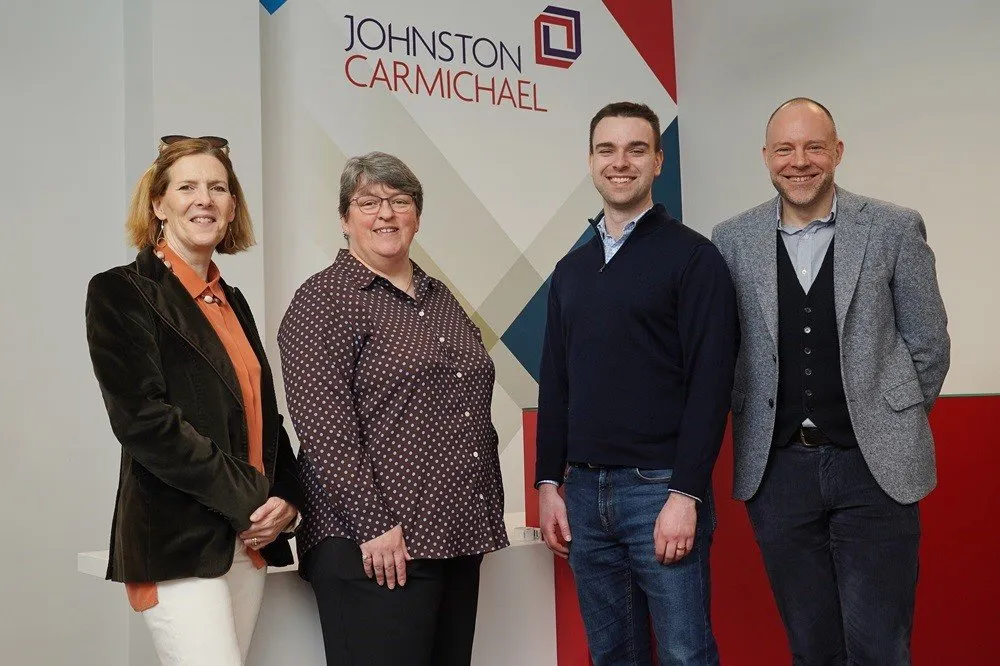
That collaboration is also reinforced through a two-way relationship. AccelerateHER’s CEO, Elizabeth Pirrie, sits on Johnston Carmichael’s Tech Advisory Board, a group of industry experts including founders, investors, and advisors who provide real-time insight into what’s happening on the ground.
“The purpose of that board is to listen and sense check what we’re doing,” Calum explains. “We’re hearing first-hand what founders are experiencing, the challenges they’re facing, and making sure our strategy is focused on the right areas.”
For Johnston Carmichael, this isn’t just about giving support; it’s about continuously refining how they show up for founders.
“It’s fantastic to have Elizabeth on that board, feeding in what she’s seeing through her conversations with founders. That real-world feedback is invaluable.”
Building the foundations: Where AccelerateHER fits
Having worked extensively across the startup landscape, including at Tech Nation, Calum has a clear view of how different programmes fit together.
AccelerateHER, in his eyes, plays a foundational role.
“It’s about helping founders go from zero to one, getting the fundamentals in place, securing early funding, and building towards that point where they’re ready to scale.”
This is the stage where many businesses are most vulnerable.
Not because the ideas aren’t strong, but because the infrastructure, knowledge, and support systems haven’t caught up yet.
And that’s exactly where partnerships like this come into their own.
Through programmes like the Female Founder Accelerator, Women to Women, and Ready to Raise, founders are not only building their businesses but also building the confidence, capability, and clarity required to grow them sustainably.
“We support founders right the way through the entrepreneurial lifecycle from incorporation and early-stage setup, through scaling, internationalisation, and even exit.”
With specialist teams across areas such as VAT, R&D tax credits, SEIS/EIS, and employee share schemes, founders can access deep, relevant expertise at each stage of growth without having to navigate these areas alone.

What separates businesses that scale from those that stall?
When asked what differentiates companies that successfully scale from those that don’t, Calum doesn’t start with funding, product, or even team.
He starts with a mindset.
“The best founders we support aren’t constrained by geography.”
It’s a deceptively simple insight, but one with significant implications.
Too many founders, particularly in smaller ecosystems, default to thinking locally: local investors, local customers, local team, local opportunities.
But the founders who break through?
“They have a global mindset right from the off… they’re going where their customers are, where the talent is, where the funding is, whether that’s London, the US, or Europe.”
Alongside this ambition comes a second, equally critical factor: commercial clarity.
“We see a lot of companies with really novel IP, cutting-edge technology, but they haven’t quite found the commercial model that turns that into a sustainable business.”
Calum emphasises something that comes up repeatedly throughout our conversation:
You have to test the commercial model early, even while you’re still building.
“Have those conversations with customers, sense check what you’re building, how you’re pricing it, how you’re going to sell it, even if you’re still in the R&D phase.”
Because ultimately:
“If you’re not generating money, you can have the best technology in the world, but you don’t have a business.”
The financial blind spots founders don’t see coming
One of the most valuable aspects of Johnston Carmichael’s involvement in AccelerateHER programmes is the visibility it gives them into recurring financial challenges.
And interestingly, these are often foundational challenges.
“People still struggle with understanding their P&L, how that feeds into the balance sheet, and crucially, cash flow.”
Cashflow, in particular, is where things become very real, very quickly.
“You need to understand your projected incomings and outgoings and identify early where there might be a gap, or where you’re heading into negative territory.”
This isn’t just about financial literacy; it’s about control and foresight.
Because when founders don’t have a clear view of their cash position, everything else becomes harder:
- Hiring decisions
- Product development timelines
- Investment conversations
And yet, Calum is quick to reassure:
“You’re not expected to be an expert in accounting or tax, but you do need to recognise where the gaps are.”
That recognition and willingness to seek support are what separate founders who stay in control from those who become reactive.
In many cases, the questions founders bring aren’t simple.
“We often bring in specialists from across the firm, whether that’s VAT, tax incentives, or share schemes, to help founders navigate very specific challenges.”
It’s this ability to go beyond surface-level advice that allows founders to not only understand their numbers but also make informed decisions with confidence.
When finance becomes a bottleneck (and what to do about it)
There’s a moment many founders reach, often without realising it, where finance shifts from being a background task to a growth blocker.
Spreadsheets get more complex. Reporting takes longer. Decisions feel slower.
That’s usually the signal.
“It comes down to your time. When finance starts becoming too much of a distraction from the parts of the business you should be focusing on for growth.”
And yet, hesitation to outsource this is common, often driven by cost concerns.
“There’s always that reluctance; you’re managing budgets closely, and bringing in external support feels like an extra cost.”
But the real cost?
Time. Focus. Missed opportunities.
“You need to think about it in the broader scheme. If it’s taking too much of your time, it’s worth speaking to an advisor.”
Importantly, this doesn’t have to mean a full-time hire.
“There are different ways to do it; fractional CFOs, bookkeeping services, flexible support depending on your stage and budget.”
It’s not about outsourcing responsibility, it’s about bringing in the right expertise at the right time.
Building a finance function that can scale with your business
One of the most practical and often overlooked parts of scaling a business is building a finance function that can actually grow with you.
Because at a certain point, spreadsheets and manual processes stop being enough, and start holding you back
“You need to think about the finance function you’re building in the company, and how that might be scalable as you grow.”
In the early days, it’s common for founders to manage finances themselves, often through spreadsheets or basic tracking.
But as the business grows, that approach can quickly become a limitation.
“You can automate a lot of that through using accountancy tools, it’s a lot less manual than updating a spreadsheet.”
Tools like Xero, QuickBooks and other cloud-based accounting platforms provide a strong foundation:
- Real-time visibility of your financial position
- Integration with your business banking
- Reduced manual input and human error
- A clearer, more consistent view of your numbers
This isn’t just about efficiency; it’s about having confidence in your data.
Because once your numbers are accurate and up to date, you can start using them to make better decisions.
Forecasting and scenario planning: preparing for what comes next
But having clean data is only the starting point.
Where things become really powerful is in how you use that data to plan ahead.
“Your projections are vital to that fundraising conversation.”
Investors don’t just want to understand where your business is today; they want to understand where it’s going, and how resilient that journey is.
That’s where forecasting and scenario planning come in.
Calum describes a simple but critical approach:
“You should have a scenario where things go to plan and then a more conservative scenario where maybe you don’t land that big customer, and what that means for your cash flow.”
This kind of planning allows founders to answer key questions:
- What happens if revenue is delayed?
- How long does your runway actually last?
- When do you need to hire or hold back?
- What are the pressure points in your business?
It’s not about predicting the future perfectly, but rather being prepared for different outcomes, and making decisions with that in mind.
It’s also about being able to clearly communicate that thinking to investors, showing not just ambition, but control, awareness, and preparedness.
Turning finance into a strategic tool (not just a reporting function)
Alongside core accounting software, Calum also highlights the value of tools designed specifically for forecasting and planning.
“We see tools like Fathom being really useful, focusing on forecasting and scenario planning.”
These tools allow founders to:
- Model different growth scenarios
- Understand unit economics more clearly
- Test assumptions before committing to decisions
- Build more credible, data-backed narratives for investors
And importantly, they shift finance from being reactive to being strategic.
“It gives you that foundation to say, we’re forecasting growth, but can we actually deliver on that?”
Because ultimately, scaling isn’t just about ambition.
It’s about building a business that can support that ambition, operationally, commercially, and financially.
The growth trap: why revenue alone isn’t enough
One of the most insightful parts of our conversation centres on a concept many founders underestimate: unit economics.
On paper, growth looks simple.
Revenue up 40% next year? Great.
But beneath that headline number lies a more complex reality.
“Is the business actually equipped to deliver that growth?”
Calum breaks it down:
- Do you have the team capacity?
- Do you need to hire?
- Do you need to invest in inventory upfront?
- Can your operations handle the increase?
“If you sell one more unit, what are the knock-on implications?”
This is where many founders get caught out.
Because growth, without planning, can strain a business just as much as stagnation.
And it’s exactly the kind of detail investors will dig into.
What traction investors really want to see (it’s not just revenue)
The conversation around investment readiness has evolved.
It’s no longer enough to have a strong idea or even a working product. Today, investors are looking for evidence.
“They want to understand the traction, what data points do you have that show the market actually wants this?”
For pre-revenue businesses, this is especially important, and increasingly expected.
But traction doesn’t always mean revenue.
It means proof of demand.
It means demonstrating, clearly and credibly, that you’re not building in isolation.
It can look like:
- Customer conversations
- Product demos
- Early pricing discussions
- Waitlists and engaged audiences
What’s particularly interesting is how this varies by business model.
B2B: Proving demand through conversations and validation
For B2B founders:
“It’s about demonstrating that you’ve had conversations with prospective customers, you’ve demoed the product, and you’ve had discussions around pricing and payment models.”
Even without signed contracts or letters of interest, these early signals matter.
- Have you spoken to your target customers?
- Have they engaged with your product or prototype?
- Have you tested how much they’d be willing to pay?
These are the kinds of insights investors look for because they show commercial thinking early on, not as an afterthought.
DTC: Building demand before you launch
In contrast, direct-to-consumer businesses, and particularly sectors like gaming, with which Johnston Carmichael works a lot, have a different opportunity.
Here, traction can be built publicly.
“Even if you’re pre-launch you can be showing demos online, building a following, getting people to join a waitlist or subscribe for updates.”
Calum points to gaming as a strong example:
“You can have a page on a platform like Steam – where people can wishlist the game, follow updates, you’re building anticipation ahead of launch.”
This kind of engagement becomes a powerful signal:
“You can go to investors and say, ‘ Look, I’ve already built a following. People are waiting for this’.”
This is both validation and visibility at play.
“Even if you’re months away from launch, you should be building that pipeline showing that you’re not building in isolation.”
And that’s really the crux of it.
Whether you’re B2B or DTC, early-stage or scaling, investors are asking the same question:
Is there real demand for this?
This shift reflects a broader trend:
“Investors are being more rigorous with their due diligence.”
Which means founders need to be more rigorous in their preparation, not just building products, but building evidence.
Because in today’s funding environment, belief isn’t enough.
You have to demonstrate it.
Funding: Why more isn’t always better
One of the most surprising realisations founders often have?
“They don’t actually need as much funding as they thought, or not as early.”
In a culture heavily influenced by venture capital narratives and people watching Dragon’s Den, it’s easy to assume that raising investment is the goal.
But Calum challenges that assumption.
“Equity funding is right for some businesses, but not for all.”
There are alternatives:
- Grants
- Venture debt
- Bank loans
- Revenue-led growth
“You shouldn’t just assume you’ll go down the equity route it might not be the right time, or the right fit.”
And importantly, raising investment comes with trade-offs:
- Giving away equity
- Increased pressure
- Significant time commitment
It’s a strategic decision rather than the default.
The real value of ecosystem support

For Johnston Carmichael, their partnership with AccelerateHER isn’t just about visibility; it’s about meaningful contribution.
“It’s about impact. How many founders are we supporting, what value are we adding, and what difference is that making?”
But the impact isn’t one-sided.
There’s a human element that Calum returns to repeatedly.
“We can see almost immediately the value in what we’re doing, hearing about the growth, the success stories, it’s incredibly rewarding.”
It reconnects advisors with the people behind the numbers. It also gives the team a real-time view of what founders are experiencing on the ground, including the challenges, opportunities, and gaps that still exist in the ecosystem.
“Sometimes you can feel one step removed working on complex tax returns, etc., but working directly with founders brings that back into focus.”
Lorem ipsum dolor sit amet, consectetur adipiscing elit. Ut elit tellus, luctus nec ullamcorper mattis, pulvinar dapibus leo.
Why Calum has so much respect for founders

Towards the end of our conversation, the tone shifts from technical advice to something more personal.
Because beyond the spreadsheets, forecasts, and funding rounds, there’s something else driving this work.
Respect.
“I have so much respect for founders. So many people can identify a problem and complain about it, but it takes real commitment and courage to actually do something about it.”
To take an idea and turn it into something real.
To take a risk.
To try, and potentially fail, in pursuit of solving a real problem.
“That needs to be recognised and supported.”
And the impact of that courage?
It ripples far beyond individual businesses.
“These companies are driving economic growth through employment, innovation, and the products they’re building.”
But it doesn’t stop there.
“There’s also the societal impact, whether it’s healthcare, wellbeing, or net zero. These businesses are solving real problems.”
This is why supporting female founders matters. Not just for founders and partnerships.
But for the wider economy and society as a whole.
Building with clarity, confidence, and the right support
If there’s one thread that runs through everything Calum shared, it’s this:
You don’t have to do everything alone, but you do need to understand what matters.
That means:
- Thinking with global ambitions from early on
- Testing your commercial model early
- Understanding your numbers, especially cash flow
- Planning for growth, not just chasing it
- Exploring all funding options, not just equity
- And knowing when to bring in expert support
Because scaling a business isn’t just about moving faster. It’s about building something that can actually sustain that growth.
And with the right partnerships, like the one between Johnston Carmichael and AccelerateHER, founders aren’t just given advice.
They’re given the clarity to make better decisions, the confidence to move forward, and the support to build businesses that last.